



- For people who are experiencing or have experienced human trafficking
- Multilingual, confidential and free
- 24 hours a day, 7 days a week
- Phone and chat
- 1 833 900-1010
- Home | Canadian Human Trafficking Hotline

First Experiences
Preparing for when you first arrive can make the adjustment process smoother and help you manage your emotions and get your bearings.
Key messages
- Getting settled in a new country involves major changes. Taking time to adjust can help with this transition.
- The first months can be particularly challenging, but every challenge you overcome helps with your adaptability, self-confidence and well-being.
- It is important to know how to recognize signs of stress or depression and ask for help if needed.
At the airport
First week
The first few days in a new country are often an intense adjustment period. Stay positive and flexible: every challenge you overcome is a victory!
Myth. “It won’t take me long to feel at home in Québec.”
Feeling at home in a new place doesn’t happen overnight. It depends on multiple factors, like the amount of time you have spent here, your habits, your relationships and your living conditions. It is normal to feel happy in Québec without feeling completely at home. It is also possible to be attached to more than one place at a time. Feeling at home and attached to a place is personal. It varies from one person to another.
Source: Hanley, J., Al Mhamied, A., Cleveland, J., Hajjar, O., Hassan, G., Ives, N., … & Hynie, M., 2018
Exploring your new environment
Everything seems new? Not sure where to start? Don’t worry: it is normal to feel lost at first.
Some tips to get your bearings and feel more comfortable in your daily life:
- Locate essential services near you (grocery stores, support services, hospitals or clinics, banks, administrative services, etc.).
- Take the time to get to know your neighbourhood (public transit, parks, restaurants, etc.).
- Make a list of things to prioritize.
“Arriving is like untangling a ball of yarn with its strands all twisted. There are so many things to take care of! If you pull on all the strands at once, things get worse. You have to pull one strand at a time, gently. Break each task down into small steps and gradually, the yarn will untangle. You’ll take control of the situation again.”
First months
Starting with the basics
Did you know?
You can start certain processes and receive guidance from abroad thanks to this service offered by the MIFI: Accompagnement Québec | Government of Québec
Depending on your situation, there will be multiple steps to take in the first few months: finding a place to live, getting a phone number, opening a bank account, finding a job, etc. These steps take time, resources and energy.
Expenses like rent, furniture, transportation, clothing and food can also add up quickly.
During this adjustment period, you may also find that life in Québec is different than you imagined.
Tips:
- Be patient and kind to yourself.
- Don’t try to understand or do everything right away.
- Remember that every step brings you closer to your objective.
- Look at the process of settling in as an opportunity to explore and get to know Québec.
- Finding a temporary job can help stabilize your financial situation while you wait to find a job that matches your skills and aspirations.
Don’t hesitate to ask for support and advice from:
- People you know in Québec
- A community organization offering support to immigrants and refugees
- R Your sponsor (private sponsorship) or your host organization
- IS Resources available on the campus of your educational institution
“When I arrived, I hoped to find a job as an engineer right away, but then the reality of the situation hit me. I was frustrated and stressed, and the bills were piling up. Friends who had already been here for a long time told me to improve my French, adjust my CV and consult an employment integration organization. I was able to find a job outside my field, which gave me my first experience in Québec. I learned the importance of keeping an open mind and asking for help.”
To find out more
Feeling lonely
When they leave their country, many people are separated from their family and friends. This separation can make them feel disconnected and alone, especially if they have no support system in Québec.
The feeling of loneliness can be worse for teenagers and young adults, who might have trouble :
- Building a new friend group
- Maintaining good relationships with their parents
- Fitting in at school or during social activities
Tips:
- Keep in touch with your loved ones virtually (calls, messages, etc.). Even from a distance, their support is important.
- Keeping the time difference and everyone’s schedules in mind can help with planning.
- Learn the local language and culture.
- Ask friends, people from your country of origin, community organizations or mental health resources for help. Feeling supported and understood can make it easier to adjust to a new country.
“At first, I felt sad. I didn’t have any friends here. I really missed my big brother, who couldn’t come with us. Mom also seemed lonely. Luckily, the church that sponsored us invited us to its activities. My little sister and I met kids our age who spoke our language. Mom made friends who took us to the park. Bit by bit, things got better.”
Overcoming the language barrier and accessing public services
In Québec, French is the only official language. Not knowing French can be stressful. It can affect daily social interactions and limit job opportunities. It can also make it stressful to access some public services.
This is why learning French can be an important step for immigrants and refugees who come to Québec.
To find out more
Did you know?
- For the first 6 months, you have the right to receive public services in a language other than French.
- Interpreting and translation services are offered in some regions. You may have to wait. Institutions must inform you that a free and confidential interpreter is available.
- After 6 months, public organizations must assess your needs and provide services in French, except in health care and public safety.
- You cannot be denied emergency or health services because of the language you speak.
- Speaking French can give public service employees (for example, in the health and social services sector) a better understanding of your needs.
Adjusting to a new environment
Being in a new environment can be unsettling and confusing. This is what some people call culture shock. Differences in behaviour, social norms and even food can make adjusting more difficult than expected.
You might have trouble adjusting to your new environment in the first weeks after you arrive. Know that this can:
- Vary from one person to another
- Last a long time
- Affect both adults and children
- Affect your well-being, especially if you don’t recognize the signs
Don’t worry: the challenges you are experiencing can be overcome. They are part of the normal adjustment process. With an open-minded attitude and patience, you will start to get more out of your experience in Québec.
To find out more
Signs to look for to take care of your well-being after you arrive
Experiencing hardship when you arrive in a new country is common.
Pay attention to your:
- Feelings
- Thoughts
- Behaviours
- Physical sensations in your daily life
You may feel stressed even if you are happy or relieved to be in Québec. This is a normal reaction to constantly facing new situations that require you to adapt. Most of the time, this stress goes away over time. But sometimes, the reaction is more intense and persistent, and may be accompanied by feelings of depression. This is called an adjustment disorder.
Children and teenagers may also feel stressed when they arrive, although they may not express it clearly. Observing their emotions and behaviours will help you understand them and support them better.
Signs of stress or depression to watch for
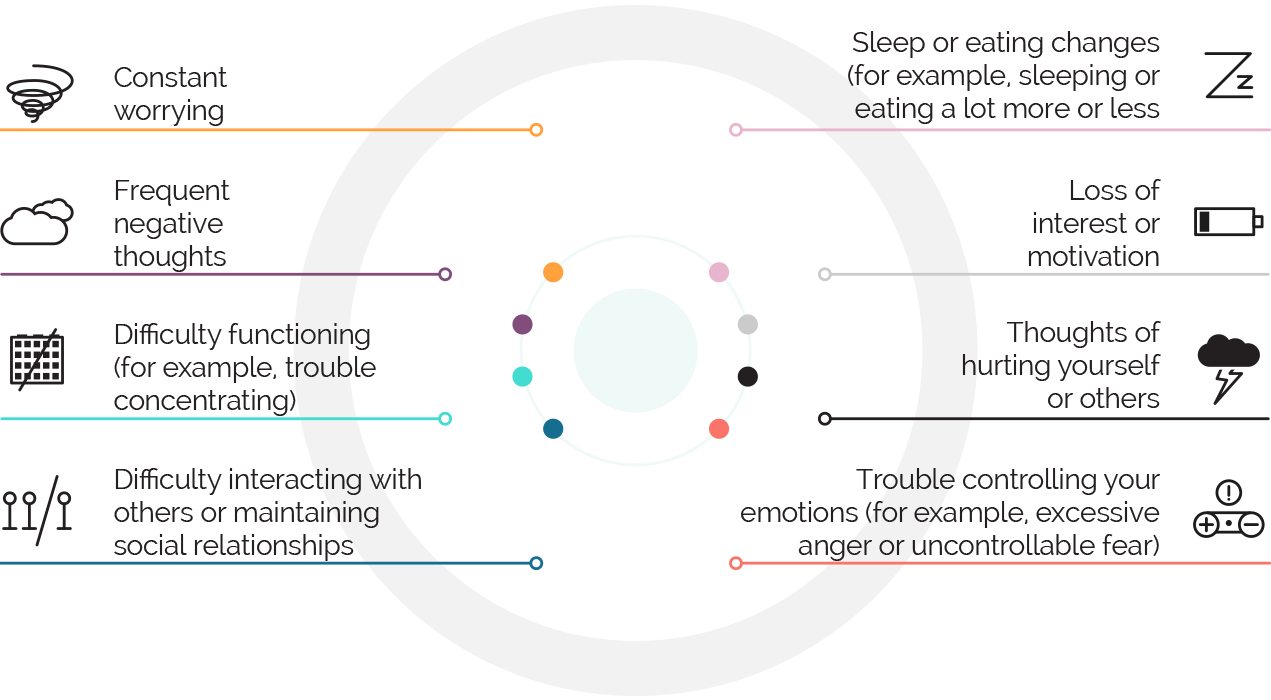
This list is for reference only. The signs can change over time and based on your experiences.
Self-care is essential. Talk to someone you know or a health and social services professional if:
- You are showing signs of stress or depression
- Your condition is affecting your daily life (your job, studies, family responsibilities, etc.)
- What you are experiencing is very intense or is not going away
- You are concerned about someone you know
Don’t wait until the situation gets worse to ask for support. Free and confidential resources are available 24/7.
Aéroports de Montréal. (2024). Douanes et immigration. YUL Aéroport International Montréal-Trudeau. https://www.admtl.com/guide/atterrir-a-montreal/douanes-immigration-canadahttps://www.admtl.com/guide/atterrir-a-montreal/douanes-immigration-canada
Éducaloi. (2023). Loi 96 : Quand pouvez-vous utiliser une langue autre que le français ? https://educaloi.qc.ca/decryptage/loi-96-quand-pouvez-vous-utiliser-une-langue-autre-que-le-francais/https://educaloi.qc.ca/decryptage/loi-96-quand-pouvez-vous-utiliser-une-langue-autre-que-le-francais/
Gouvernement du Québec. (2024). Après avoir obtenu votre permis de travail. https://www.quebec.ca/immigration/permanente/immigrer-affaires/investisseurs/apres-permis-travailhttps://www.quebec.ca/immigration/permanente/immigrer-affaires/investisseurs/apres-permis-travail
Gouvernement du Québec. (2025). Gérer le stress, l’anxiété et la déprime. https://www.quebec.ca/sante/sante-mentale/s-informer-sur-sante-mentale-et-troubles-mentaux/favoriser-bonne-sante-mentale/gerer-stress-anxiete-et-deprime
Hanley, J., Al Mhamied, A., Cleveland, J., Hajjar, O., Hassan, G., Ives, N., … & Hynie, M. (2018). The social networks, social support and social capital of Syrian refugees privately sponsored to settle in Montreal: Indications for employment and housing during their early experiences of integration. Canadian Ethnic Studies, 50(2), 123-148. https://dx.doi.org/10.1353/ces.2018.0018
Practical Tips
Here is some useful information to start settling in and recognize risky situations.
Key messages
- Planning ahead for the first steps you need to take helps you feel more in control when you arrive in Québec.
- Knowing which sources of information are reliable allows you to proceed safely. Always rely on information from the Government of Québec or the Government of Canada first.
- Check if you are eligible for public health and prescription drug insurance. If you are not eligible, it is strongly recommended that you take out private insurance and additional insurance policies.
Important steps to take when you arrive in Québec
This unique and confidential number allows government services to identify you.
It gives access to:
- The right to work in Canada
- Government of Canada programs and benefits (for example, employment insurance, financial assistance, etc.)
To apply, you will need:
- Valid proof of identity (passport, etc.)
- Immigration documents
To do:
See Apply, update or obtain a SIN confirmation | Government of Canada.
Important
It is against the law for other people to use your SIN. To prevent fraud, don’t give your SIN to just anyone.
To find out more: Protecting your SIN | Government of Canada.
There are public (RAMQ or IFHP) and private insurance plans, depending on your migration status.
They give you access to:
- Health services and social services
To apply, you will need:
- Valid proof of identity (passport, etc.)
- Immigration documents
To do:
- See Eligibility conditions for health insurance | RAMQ and Newcomers: register for health insurance online | RAMQ
- People subject to a waiting period before health coverage begins (generally 3 months) or who do not have access to RAMQ: it is recommended that you take out private insurance and additional insurance policies, for example for services related to pregnancy or mental health.
- R When you arrive in Québec, you are automatically covered by the IFHP. At the airport, you will receive an IFHP eligibility document. If you do not receive it, visit Application for IFHP | Government of Canada or ask your host organization or sponsor for help. You are covered by the IFHP while you wait to receive your RAMQ health insurance card.
- IS Health and hospital insurance is mandatory for you and any family members who are accompanying you for the duration of your studies. If you are not eligible for the RAMQ, check what coverage is included in the private plan offered by your educational institution.
- TFW Find out how to register for the public plan (RAMQ) or take out private insurance coverage.
To find out more
This gives you access to:
- The right to drive in Québec
To do:
- Visit Newcomers: obtaining a driver’s licence | Société de l’assurance automobile du Québec to find out what conditions apply for:
- A Québec licence
- Driving without a Québec licence
This gives you access to:
- Direct deposits for your pay, financial assistance and tax credits
- Paying bills
- Credit card
- Transfers between bank accounts
To apply, you will need:
- Proof of identity (passport, etc.)
- Immigration documents
- Valid mailing address (can be temporary)
- Canadian phone number
To do:
- Find out about the different banks and types of accounts available
- Learn the difference between debit cards and credit cards.
- See Opening a bank account | Government of Canada
Did you know?
You have the right to open a bank account with a Canadian bank, credit union or authorized foreign bank. This applies even if:
- You do not have a job
- You do not have money to deposit at first
- You have declared bankruptcy before
To apply, you will need:
- A Canadian credit card for a monthly plan
- Cash or a Canadian debit card for a reloadable prepaid SIM card
To do:
- Find out about the different providers and residential and mobile service plans available.
Steps to follow for families with children
Optional childcare services for children aged 0–5 in different settings (childcare centre (CPE), subsidized daycare, unsubsidized daycare, etc.).
They give you access to:
- Time for parents to work
- A stimulating learning environment for children
To start the process, you will need:
- Immigration documents
- A Canadian phone number (can be temporary)
- A mailing address in Québec (can be temporary)
To do:
- Learn about the Types of recognized daycares | Government of Québec
- Register your child using the online gateway : Childcare Services Registration Portail | Government of Québec
- Start the process several months before you arrive in Québec. Places are limited and wait times are long.
- See Québec’s School System.
School is compulsory for children aged 6 to 16.
This gives you access to:
- Public education (free)
Important
It is recommended that you have permanent accommodation first so your child doesn’t have to change schools.
To do:
- Register your child with one of the Centres de services scolaires du Québec | FCSSQ closest to the family home.
- See Québec’s School System.
Financial assistance from the Government of Québec and the Government of Canada for families with children under 18.
To apply, you will need:
- At least one parent with Canadian citizenship, permanent residency or a temporary resident permit
- Other conditions apply
To do:
Renting an apartment
Recommended:
- Have the amount of money (in Canadian dollars) required by IRCC to support yourself and your family.
- Make sure you have enough money to cover short-term rental costs when you arrive.
- Find out the average monthly rent in your new city using the Canada Mortgage and Housing Corporation’s search engine.
“My wife and I had no idea the cost of renting a two-bedroom apartment for ourselves and our daughter would be so high. We started by renting a temporary furnished apartment in an area close to downtown. Then we looked for a long-term apartment that would meet our needs.”
Did you know?
Québec has been experiencing a housing crisis for several years:
- Few apartments are available to rent
- Rents are high
Average monthly rent in Québec towns and cities of 10,000+ people:
- 2022 – $952
- 2023 – $1,022
Ideally, rent and related expenses should not be more than 35% of your gross income. Otherwise, it can be hard to pay for other expenses or save money. In large cities in Québec, respecting this guideline can be difficult.
To find out more
Other expenses:
Essential items
- Furniture
- Appliances
- Kitchenware and everyday items
- Appropriate clothing for winter in Québec
Essential services
- Heat
- Electricity
- Home insurance
- Internet
To buy furniture, appliances and other necessary items at a lower cost :
- Second-hand stores
- Online ads
- Giveaway or selling groups on social media
- Community organizations
Did you know?
In Québec, apartment sizes are described using terms like 1 and a half, 2 and a half, 3 and a half, etc. The numbers indicate how many rooms there are in the apartment. The half refers to the bathroom.
To find a place to live:
- Classified ad sites (Centris, Marketplace, Kijiji, etc.)
- Groups on social media
- “For rent” signs in the street
- Advice from Host organizations | Government of Québec
R When they arrive, government-assisted refugees have access to temporary accommodation provided by a host organization authorized by the MIFI.
Important
The property owner can ask you for information to establish your identity: first name, last name and current address. They can also ask to see proof of identity to confirm this information.
However, they must respect certain limits. To find out more and defend your rights: Leases and protection of personal information | Tribunal administratif du logement.
In Québec, all tenants have rights, regardless of their immigration status. For example, a property owner cannot refuse a tenant based on their skin colour, country of origin, religion, language, etc.
Housing committees can help you learn about and assert your rights.
To find out more
- Rights and Obligations of the Lessor and Lessee | Tribunal administratif du logement
- Information tools on tenant rights | Coalition of Housing Committees and Tenants Associations of Québec
- Find a housing committee | Coalition of Housing Committees and Tenants Associations of Québec
- Logements subventionnés | Société d’habitation du Québec [French only]
Preventing risky or dangerous situations and protecting yourself
Throughout the process of getting settled in Québec, it is essential to know how to recognize risky or dangerous situations to protect yourself.
Fraud is when someone obtains another person’s personal information to steal their money or their identity.
Useful information for people who commit fraud:
“Criminals take advantage of people who aren’t familiar with how the government or businesses work. They might scare you by saying you could lose your migration status or be deported, for example.”
Tips:
- Make sure a source of information is reliable before giving personal information or money.
- Never click on links in suspicious emails, in text messages or on non-secure websites. It is recommended that you log in again on official websites.
- Contact the police (911) if you experience fraud or think you have experienced it.
- See the Clinique Cyber-Criminologie website [French only].
There are organized criminal networks that take advantage of people by depriving them of their freedom and dignity. Human trafficking can take the form of forced labour or sexual exploitation.
For advice and to be referred to the right resources
For immediate assistance
The police have a duty to protect everyone, regardless of their origin or statut migratoire.
Call 911 or go to a police station if:
- You are involved in a motor vehicle accident
- You experience or witness theft, assault or fraud
- A person you are responsible for disappears
- There is a fire
- There is a medical emergency and someone’s life is in danger
“Beware of people who want to provide you with housing, transport you or control your life in exchange for services. To get what they want, these people use threats, force, coercion or deception. For example, human traffickers might promise you permanent residency or threaten to deport you.”
Emergency services | 911
- For any emergencies (police, ambulance, fire department, etc.)
- 24 hours a day, 7 days a week
- 911
- Urgence 9-1-1 | Government of Québec [French only]
Agence du revenu du Canada. (2024). Arnaques et fraudes. Gouvernement du Canada. https://www.canada.ca/fr/agence-revenu/campagnes/fraude-arnaques.htmlhttps://www.canada.ca/fr/agence-revenu/campagnes/fraude-arnaques.html
Boucher, G. (2024). Rapport de la SCHL sur le marché locatif : La crise du logement risque d’exacerber les inégalités au Québec. Observatoire québécois des inégalités. https://observatoiredesinegalites.com/marche-locatif-crise-logement/
Centre d’expertise sur le bien-être et l’état de santé physique des réfugiés et des demandeurs d’asile (CERDA). (2025). Droits et protections. Carnets de route. https://carnetsderoute.info/info/droits-et-protections/
Salazar, F. (2024). Une ligne d’urgence pour contrer la traite des personnes. Immigrant Québec. https://www.infotetquebec.com/une-ligne-durgence-pour-contrer-la-traite-des-personnes/https://www.infotetquebec.com/une-ligne-durgence-pour-contrer-la-traite-des-personnes/
Resources for Newcomers
Using free support services can make it easier to get settled in Québec.
Key messages
- Government, institutional and community resources are available to support you, depending on your situation.
- Getting the right support from the moment you arrive can help you adapt more easily and reduce stress.
- Feeling welcomed can help motivate you to successfully get settled in Québec.
Where to start?
These 2 resources can help you start the process of getting settled and direct you to the right services.
Accompagnement Québec
- Free and personalized public service for immigrants and refugees
- Accessible abroad and throughout Québec
- Access to an integration assistance agent from the MIFI
- Needs assessment (settling in, recognition of skills, employment, French classes, immigration. etc.)
- Personalized action plan
- R Support for the specific needs of sponsored refugees
- Accompagnement Québec | Government of Québec
Premières démarches d’installation (First steps to settling in) Information Session
- Free 3-hour information session offered by community organizations offering support to immigrants and refugees throughout Québec
- Information on various steps you need to take (RAMQ, bank account, registering for school, moving to a rural area, etc.)
- Knowledge of French required
- TFW IS Eligibility verification required
- Premières démarches d’installation (First steps to settling in) Information Session | Government of Québec
What is your situation?
Click on your migration status to find out which services services are available.
Settling in
Government-assisted refugee
The MIFI has authorized a host organization to meet you in your destination city and assist you with your installation process.
For you, this includes:
- Temporary accommodation when you arrive
- Making an appointment for your physical health and wellness assessment with your local refugee health team
Community organizations offering support to immigrants and refugees
- Free community services for immigrants and refugees
- Information to help you settle in (RAMQ, SIN, driver’s license, daycare registration, finding housing, etc.)
- Referrals to appropriate resources (employment, housing, health, education, etc.)
- Information on Québec society
- Intercultural exchange program
- Partner community organizations | Gouvernment of Québec
- R Host organizations | Government of Québec
Privately sponsored refugee
Your sponsor makes a formal agreement with the Government of Canada to support you for your first year in Québec.
Their responsibilities are:
- Providing for your basic needs
- Supporting you as you settle in
- Finding and paying for suitable accommodation for you
- Helping you get around
Don’t hesitate to ask them for support.
To find out more
Physical Health and Wellness Assessment
When you arrive, you have access to a physical health and wellness assessment provided by your refugee health team. Your host organization or your sponsor is responsible for making an appointment for you.
Know that:
- This assessment is recommended, but entirely voluntary.
- It gives you a better idea of your health and your family’s health without delay.
- It allows you to be referred to resources that meet your physical and psychosocial health needs.
- It is free.
- Your medical results will not influence your immigration process or your access to services.
Your assessment is done at 2 appointments:
- A first appointment within your first 30 days in Québec
- A second appointment within your first 90 days in Québec
You can receive services in your language if interpreters are available. Community counsellors sometimes speak multiple languages. If not, they can help you find interpreting services.
Important
Don’t go to a refugee health clinic without an appointment. Your host organization or your sponsor is responsible for contacting them for you.
See the map below to find the refugee health team in your region.
When you arrive, you can get help from community organizations that support immigrants and refugees. Don’t hesitate to contact an organization near you.
Community organizations offering support to immigrants and refugees
- Free community services for immigrants and refugees
- Information to help you settle in (RAMQ, SIN, driver’s license, daycare registration, finding housing, etc.)
- Referrals to appropriate resources (employment, housing, health, education, etc.)
- Information on Québec society
- Intercultural exchange program
- Partner community organizations | Gouvernment of Québec
- R Host organizations | Government of Québec
Your family in Québec can help you settle in and refer you to appropriate resources. You also have access to the services of community organizations offering support to immigrants and refugees.
Community organizations offering support to immigrants and refugees
- Free community services for immigrants and refugees
- Information to help you settle in (RAMQ, SIN, driver’s license, daycare registration, finding housing, etc.)
- Referrals to appropriate resources (employment, housing, health, education, etc.)
- Information on Québec society
- Intercultural exchange program
- Partner community organizations | Gouvernment of Québec
- R Host organizations | Government of Québec
CEGEPs and universities
Your educational institution is your first stop for support when you arrive.
General orientation activities
These activities:
- Take place several days before classes start
- Are an opportunity to meet students and teaching staff in your program
- Include a campus tour and information on which services are available.
“Check your emails! You’ve probably received an invitation to these activities.”
Services for international students
Orientation activities
These social activities are an opportunity to meet students from Québec and around the world and learn about Québec society. Check if your CEGEP or university organizes this kind of activity.
Advisory services
Most CEGEPs and universities offer:
- Immigration advice (study permit, medical insurance, etc.)
- Information on scholarships for international students
- The Accueil Plus service
Services offered by community organizations offering support to immigrants and refugees
You also have access to the services to these services to guide you.
« These organizations can help you with the process of applying for permanent residency in Québec, for example. »
Community organizations offering support to immigrants and refugees
- Free community services for immigrants and refugees
- Information to help you settle in (RAMQ, SIN, driver’s license, daycare registration, finding housing, etc.)
- Referrals to appropriate resources (employment, housing, health, education, etc.)
- Information on Québec society
- Intercultural exchange program
- Partner community organizations | Gouvernment of Québec
- R Host organizations | Government of Québec
Dedicated services for temporary workers in the agricultural and food processing sectors
The Réseau d’aide aux travailleuses et travailleurs migrants agricoles du Québec (RATTMAQ) present at Montreal’s Pierre Elliott Trudeau International Airport to welcome TFWs in this sector. Feel free to visit the booth for information and referrals to other resources.
Réseau d’aide aux travailleuses et travailleurs migrants agricoles du Québec (RATTMAQ)
- TFW Services for TFWs in the agricultural and food processing sector
- Reception at the airport, guidance and mental health and legal support
- Phone and chat
- WhatsApp: 514-415-8077
- Montérégie, Montréal and Laval: 1 514-415-8077
- Québec and Chaudière-Appalaches: 1 581-849-7941
- Saguenay-Lac-Saint-Jean: 1 581-574-8174
- Accueil | RATTMAQ
Services offered by organizations offering support to immigrants and refugees
You also have access to these services to guide you.
Community organizations offering support to immigrants and refugees
- Free community services for immigrants and refugees
- Information to help you settle in (RAMQ, SIN, driver’s license, daycare registration, finding housing, etc.)
- Referrals to appropriate resources (employment, housing, health, education, etc.)
- Information on Québec society
- Intercultural exchange program
- Partner community organizations | Gouvernment of Québec
- R Host organizations | Government of Québec
Information for TFWs
The Info TET Québec website offers information for TFWs, including a downloadable information guide in multiple languages.
Info TET Québec
- TFW Information, support and activities for TFWs
- French, English and Spanish
- 1 888-454-3998
- WhatsApp: 438-543-5062, 438-378-5152
- Accueil | infotetquebec.com
- Downloadable information guide in French/English, French/Spanish and French/Tagalog
Centre d’expertise sur le bien-être et l’état de santé physique des réfugiés et des demandeurs d’asile (CERDA). (2025). Soins de santé. Carnets de route. https://carnetsderoute.info/info/soins-de-sante/
Centre d’expertise sur le bien-être et l’état de santé physique des réfugiés et des demandeurs d’asile (CERDA). (2025). Informations à lire avant tout. Carnets de route. https://carnetsderoute.info/info/informations-importantes/