




Support System
Key messages
- Increasing your social interactions in Québec helps you build a new support system.
- Joining different groups (national, cultural, sports, etc.) allows you to connect with your communities and meet people.
- If you feel lonely and isolated, don’t hesitate to contact the resources that are available to support you.
Feeling isolated from others
Moving to a new country means moving away from your family, friends and what you are used to.
Making new friends takes time. The language, culture and geographic isolation can also make socializing harder.
This means it is normal to feel disconnected from your support system in your country of origin and from the new people around you.
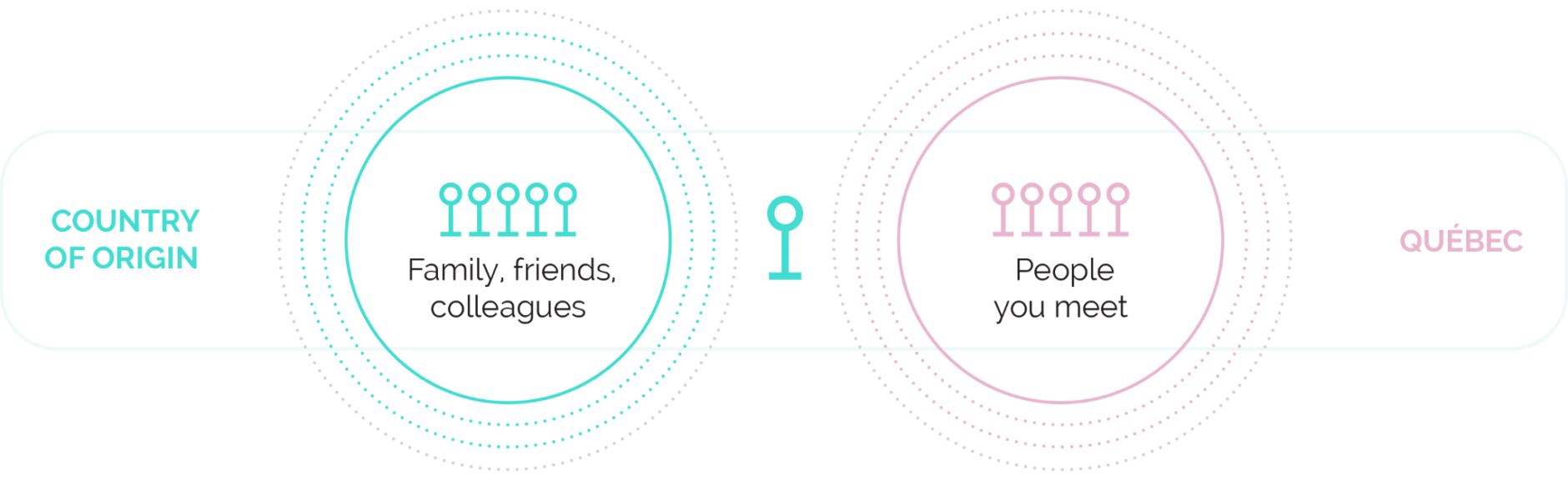
Regular social interactions, even short-term, contribute to your well-being.
Tips:
- Call your loved ones regularly and send them messages and photos.
- Make video calls (WhatsApp, FaceTime, etc.) to see your loved ones and feel like they are with you, even from far away.
- Spend more time with people (family members, friends, neighbours, acquaintances, etc.).
Diversifying your sources of support
Myth: “My well-being depends entirely on me.”
Your well-being is not completely dependent on you. It also depends on the quality of your relationships with others. In an immigration context, new friendships can be an important source of support. They also help you feel like you belong and feel less lonely. Immigrants who develop new friendships after arriving in Canada also report being in better health.
Source: IRCC., 2010
Building a solid social network in Québec makes it easier to face migration and adjustment challenges.
It isn’t the number of people in your network that counts, but the variety of connections and types of support.
You can get support from your family, friends, colleagues, acquaintances or new people you meet.
“Since we arrived, my family has received support from many people. Support from your loved ones back home is precious, and support from people we’ve met in Québec is too. People we know have given us advice on how to access health services. Some colleagues have also introduced us to activities for the children.”
Exercise
Your support system is an essential resource for your well-being!
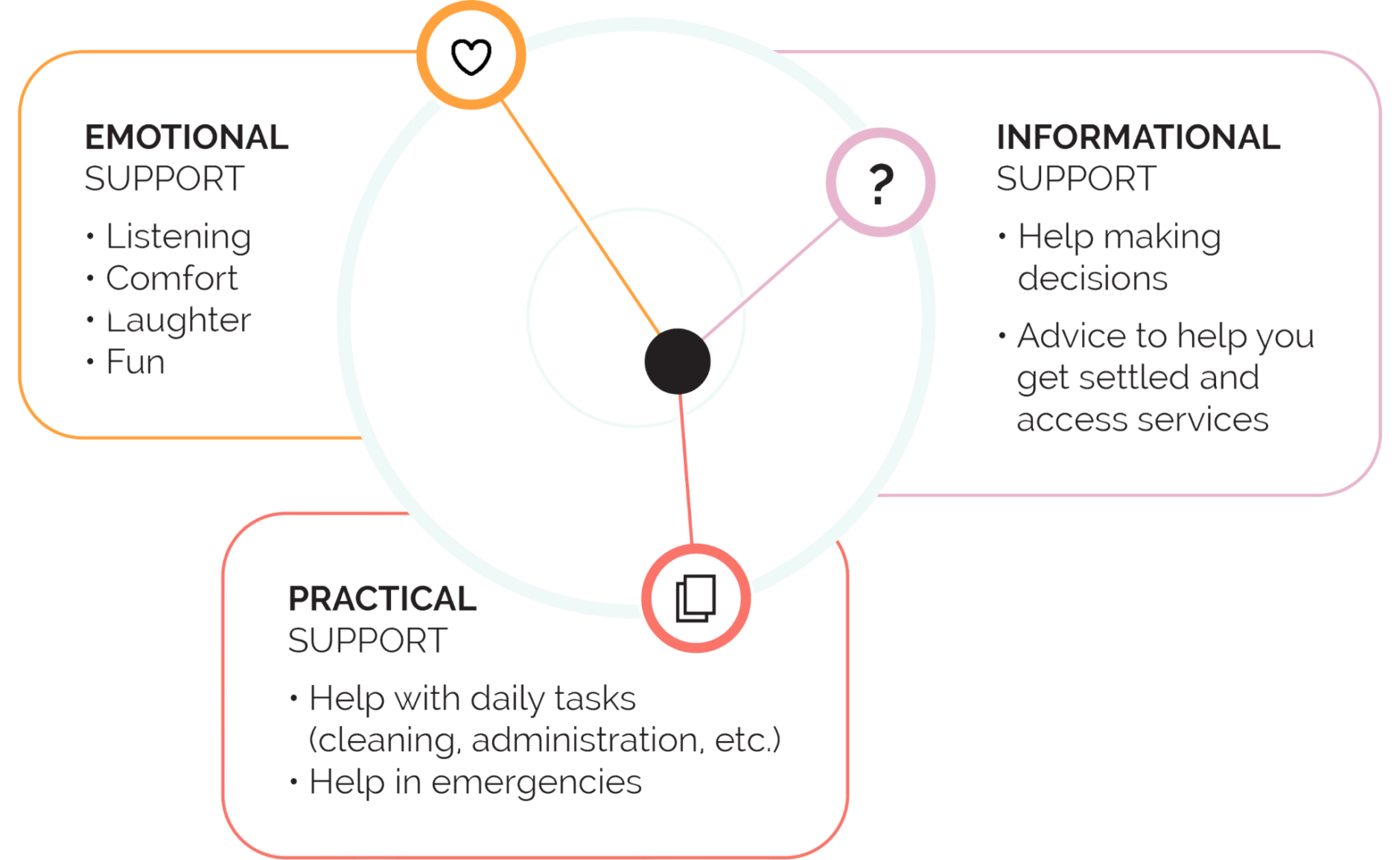
Name one or more people you can reach out to, in another country or in Québec.
- For information, I can contact …………………………
- For a listening ear, I can contact …………………………
- For a favour, I can contact …………………………
- For advice, I can contact …………………………
- For fun and distraction, I can contact …………………………
Reconnecting with your communities and exploring diversity
You can join networks of people with the same background, experiences or interests as you.
You can also join other networks and explore new activities and ways of doing things.
At first, new things might make you feel uncomfortable. This is very normal. If you experience misunderstandings or confusion, don’t isolate yourself. Talk about it and ask questions. Dialogue makes it easier to understand one another.
Over time, and the more conversations you have, you will get your bearings and feel more comfortable in your new environment.
To find out more
Asking for help outside your support system
Sometimes, confiding in the people around you is hard. For example, you might worry about being misunderstood or bothering or burdening others.
Sometimes our loved ones also don’t know how to react or provide the right support. Even with many people around you, you might feel lonely. Many people feel this way.
At times like these, talking to someone who understands what you are going through can help.
To find out more
Taking time for yourself
Spending time with others is important, but so is taking time for yourself. These simple moments allow you to recharge and reflect.
They can include:
- Taking a walk
- Reading in a park
- Walking home from work
- Doing exercise you enjoy (running, yoga, etc.)
- Going grocery shopping
To find out more
Centre de toxicomanie et de santé mentale (CAMH). (2020). Séparés, mais pas seuls : Importance des liens sociaux à un âge avancé. https://kmb.camh.ca/fr/eenet/documentation/separes-mais-pas-seuls-importance-des-liens-sociaux-a-un-age-avance
Institut national de santé publique du Québec. (2024). Facteurs qui influencent la santé mentale. Institut national de santé publique du Québec. https://www.inspq.qc.ca/sante-mentale/facteurs
Immigration, Réfugiés et Citoyenneté Canada (IRCC). (2010). État de santé et capital social des nouveaux immigrants : données probantes issues de l’Enquête longitudinale auprès des immigrants du Canada. Gouvernement du Canada. https://www.canada.ca/fr/immigration-refugies-citoyennete/organisation/rapports-statistiques/recherche/etat-sante-capital-social-nouveaux-immigrants-donnees-probantes-issues-enquete-longitudinale-aupres-immigrants-canada/section-5.html
Stick, M., Hou, F., & Kaida, L. (2021). La solitude autodéclarée chez les immigrants récents, les immigrants de longue date et les personnes nées au Canada. Statistique Canada. https://doi.org/10.25318/36280001202100700001-fra
The Refugee Centre. (2025). Soutien à la santé mentale et au bien-être. https://www.therefugeecentre.org/wellness-support
Van Orden, K. A., Bower, E., Lutz, J., Silva, C., Gallegos, A. M., Podgorski, C. A., Santos, E. J., & Conwell, Y. (2021). Strategies to Promote Social Connections Among Older Adults During “Social Distancing” Restrictions. The American Journal of Geriatric Psychiatry, 29 (8), 816-827. https://doi.org/10.1016/j.jagp.2020.05.004
Meaningful Activities
Doing activities that make you feel good is a great way to meet people and thrive in Québec.
Key messages
- Doing activities that match your interests, values or skills can be both fun and satisfying.
- Sharing moments and experiences with others through these activities can help you feel closer to them.
- Meeting new people is an opportunity to learn more about local culture.
How to find fun and satisfying activities in Québec
Tips:
This is an opportunity to:
- Build relationships with other immigrants or refugees
- Stay connected to your culture
- Help other newcomers to Québec
To find these types of associations:
- Look on the Internet and social media.
- Contact your country’s consulate or embassy.
To find out more
There are many different options: dance, music or art classes, book clubs, gardening, team sports, outdoor activities, etc.
Some sports can even teach you about local culture and help you embrace winter. Examples include hockey, ice skating, and cross-country or downhill skiing.
By participating in sports and recreational activities, you can:
- Improve your physical and mental health
- Meet people from different backgrounds
- Build new skills
- Learn Québec French
- Have fun and feel accomplished
“Not long after I came to Québec, I met a group of African students who organized football games—or soccer games, as they call it here. With a friend’s encouragement, I decided to join them, even though I hadn’t played in a while. Everyone was so nice! After a few friendly games, our team joined a municipal league. The group quickly became a circle of great friends.”
Did you know?
Some community organizations organize outdoor activities to support the inclusion of immigrants and refugees. This can be an opportunity to try winter activities and discover Québec’s natural beauty.
For example:
Tips:
- Find out what sports and recreational facilities and activities (pool, sports field, art class, etc.) are offered by municipalities and community centres.
- Take advantage of municipal, regional and national parks for walking, biking and other sports activities.
- Encourage your child to participate in activities offered by their school, the municipality or community centres.
- EE Take advantage of the activities offered by your educational institution.
“What helped me in the first few months was joining a youth group at the Assyrian church. The activities introduced me to new friends who spoke my language and gave me a place to be myself. At school, I also joined an art club. I’m learning to express my emotions through art—it’s helping me a lot!”
Practising your religion or spirituality can have a lot of benefits. For example :
- A group that shares your beliefs can be a source of support, mutual assistance and comfort
- Participating in rituals (prayer, meditation, etc.) helps reduce stress and find more balance and inner peace
- Practising your religion or spirituality keeps you connected to your values, your culture and other people
- Getting involved in your religious or spiritual community’s activities sometimes creates volunteer opportunities.
Getting involved in a group focused on a common cause or project can be good for you and others.
It allows you to :
- Make your voice heard
- Defend your rights and the rights of your community
- Contribute to social change that impacts or motivates you
- Build a more inclusive and fair society
- Contribute your time and skills to a cause while making you feel useful and valued.
Many organizations and associations organize collective action, protests or advocacy campaigns. Don’t hesitate to look into them!
To find out more
EE Check your educational institution’s website to find out what activities are offered by different student groups. Some activities are specifically designed for international students.
For example :
- Your department’s student association
- An association of students from your country or part of the world
- A sports club
- A book or study club
- A support group.
“Members of the African student association at my university gave me valuable advice when I arrived. Having a supportive space to share was essential for me. Feeling supported also helped me stay connected to my culture while I was studying in Québec. I highly recommend joining this type of group!”
Check your educational institution’s website to find out what activities are offered by different student groups.
Adjizian, J.-M., Roult, R., White, B., Auger, D. & Zheng, D. Q. (2021). Le loisir comme facteur d’intégration sociale pour les nouveaux arrivants : étude de cas centrée sur certains arrondissements de Montréal. Enjeux et société, 8(1), 220–248. https://doi.org/10.7202/1076542ar
Yu, M. (2021). Does Participating in Religious Activities Have a Long-Term Effect on the Emotional/Mental Health of Immigrants in Canada? Canadian Studies in Population, 48(1), 1-28. https://doi.org/10.1007/s42650-021-00043-1
Volunteering
Key messages
- Feeling useful and competent is rewarding and motivating.
- Volunteering can give you work experience and create networking opportunities.
- Volunteering is not an obligation: you need to want to do it and have enough time and energy.
What is volunteering?
Volunteering means using your time, energy and skills to help the community, by choice and for free.
This type of activity can benefit newcomers to Québec in many ways.
- Contributing to society, using your skills, feeling heard and appreciated, building your self-confidence
- Discovering Québec society, improving your French
- Gaining recognized experience in Canada or Québec, understanding the local job market
- Contributing to a cause, promoting values (diversity, equality, etc.), making a change, being part of something bigger than yourself
- Developing equal and supportive relationships, being part of a community
- Overcoming boredom, building relationships, finding job opportunities, getting advice
Where to volunteer
There are many options! You can volunteer with:
“When I arrived, I had to go through a long process to get my qualifications recognized. That was discouraging. I wanted to meet people and get involved. I found a non-profit organization online that focused on green construction—my field in Colombia! This experience gave me a better understanding of Québec’s job market and allowed me to expand my network. Volunteering enhances a CV and can be used as a reference.”
There are also many different tasks you can do. For example, you can:
- Raise funds
- Prepare and distribute meals
- Perform administrative tasks
- Go with people to medical appointments
- Lead group activities
Tips:
- Ask people you know in Québec.
- Explore the Je bénévole | Fédération des centres d’action bénévole du Québec website.
- Explore the Web page for prospective volunteers for the CISSS or CIUSSS in your region.
“Take time to get settled in Québec and breathe a little. Volunteering isn’t an obligation! You need to want to do it and have enough time and energy. It’s also important to have fun. There are many different volunteer opportunities, depending on your interests and skills. You can also help the people around you directly without going through an organization.”
Exercise
Find out which volunteer activities match your areas of interest by answering the following questions.
- What values or causes are important to you?
- Would you like to help a specific group of people (newcomers to Québec, seniors, children, etc.)?
- In what setting (cultural, community, educational, etc.) would you like to volunteer?
- What types of tasks do you like to do?
- Would you like to share or develop knowledge or specific skills? If so, which ones?
Ambrosini, M., & Artero, M. (2023). Immigrant Volunteering: A Form of Citizenship from Below. VOLUNTAS: International Journal of Voluntary and Nonprofit Organizations, 34(2), 252-262. https://doi.org/10.1007/s11266-022-00454-x
Guo, S. (2014). Immigrants as active citizens: Exploring the volunteering experience of Chinese immigrants in Vancouver. Globalisation, Societies and Education, 12(1), 51-70. https://doi.org/10.1080/14767724.2013.858527
Sveen, S., Anthun, K. S., Batt-Rawden, K. B., & Tingvold, L. (2023). Immigrants’ Experiences of Volunteering; A Meta-Ethnography. Nonprofit and Voluntary Sector Quarterly, 52(3), 569-588. https://doi.org/10.1177/08997640221114810