



1. True or false? In Québec, everyone speaks and understands English.
False
In Québec:
- 1 in 2 people (46%) is bilingual and speaks English and French.
- The province’s Anglophone minority makes up 13% of the population.
This may surprise you, since Canada is a mainly English-speaking country.
On the map below, you can see that:
- Québec is the only province where the first language of most the population is French.
- There are minority Francophone communities in other provinces and territories of Canada.
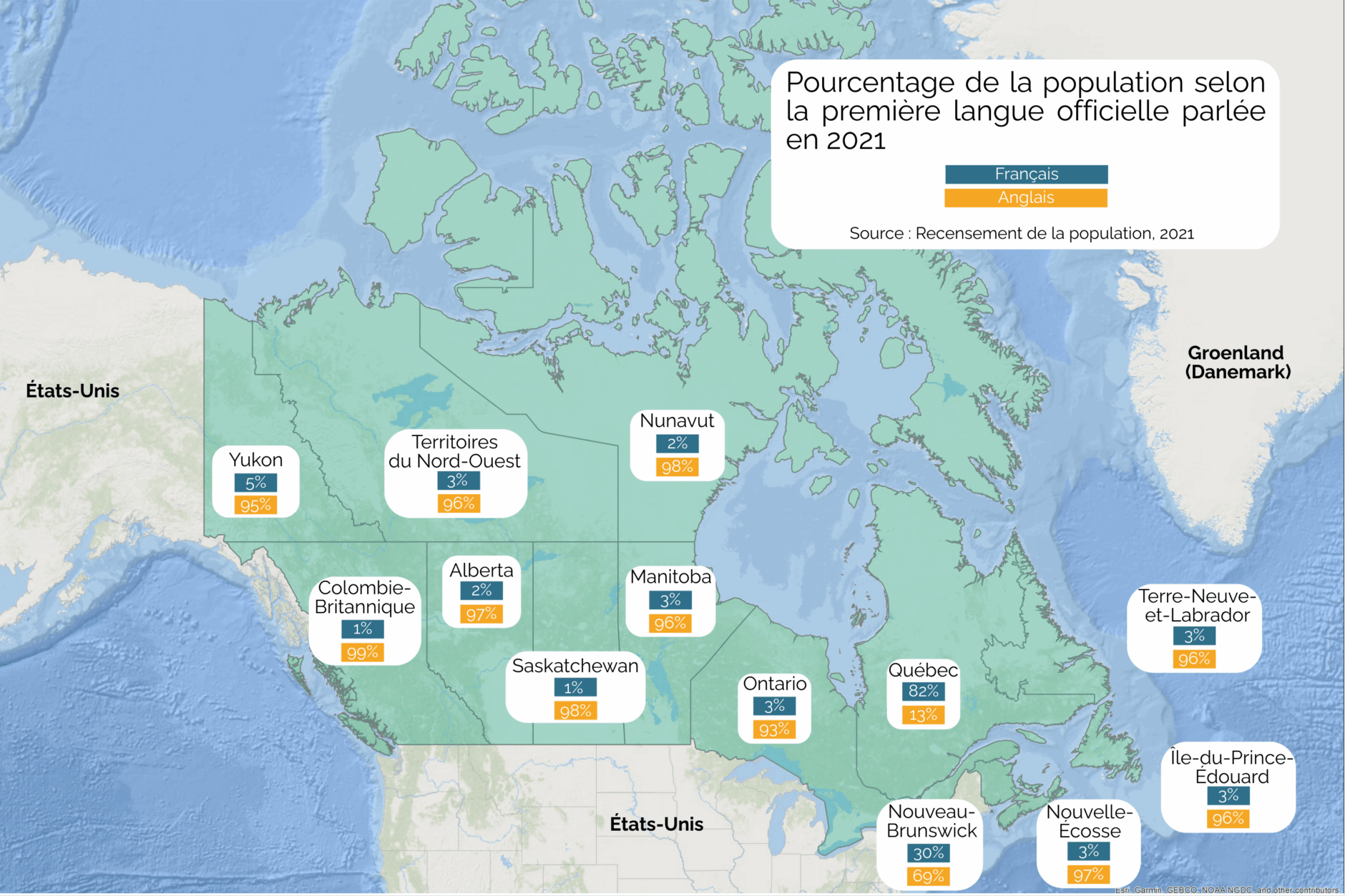
Statistique Canada. (2023). Tableau : 15-10-0032-01 Population selon la première langue officielle parlée et la géographie, 1971 à 2021. Gouvernement du Canada. https://www150.statcan.gc.ca/t1/tbl1/fr/tv.action?pid=1510003201
Statistique Canada. (2023, juin 21). Le bilinguisme français-anglais au Canada : Tendances récentes après cinq décennies de bilinguisme officiel. Gouvernement du Canada. https://www12.statcan.gc.ca/census-recensement/2021/as-sa/98-200-X/2021013/98-200-x2021013-fra.cfm
Auclair, S. C., Frigon, C., & St-Amant, G. (2023, août 22). Faits saillants sur la langue anglaise au Québec en 2021. Statistique Canada. https://www150.statcan.gc.ca/n1/pub/89-657-x/89-657-x2023016-fra.htm
2. True or false? French is the only official language of Québec.
True
Québec is the heart of the French language in North America.
It is the only Canadian province where French is the only official language. The Charter of the French Language, also known as “Bill 101,” has regulated the protection of French since 1977.
The law resolves to make French:
- The main language in public spaces (daily interactions, public services, work, school, businesses, etc.)
- The shared language of different language groups in Québec
“Speaking French is essential to find a job! Remember to get your pay stubs translated and write your CV in French.”
To find out more
3. True or false? In Québec, immigration is fully handled by the government of Canada.
False
In Québec, immigration is a shared responsibility:
- The Québec government selects the vast majority of the immigrants and refugees that settle in the province.
- The government of Canada decides if they can come to the country.
This is why the immigration process involves both governments.
4. True or false? The government of Québec promotes Francophone immigration.
True
For the government of Québec, immigration helps preserve French in the province:
- Knowledge of French is one of the selection criteria for economic immigration.
- The government offers French classes to immigrants and refugees to help them learn the language.
Immigration contributes to population growth, makes Québec more diverse and stimulates the job market.
To find out more
Gouvernement du Québec. (2024). Immigration francophone. Gouvernement du Québec. https://www.quebec.ca/gouvernement/politiques-orientations/immigration-francophone
Statistique Canada. (2022). Le Quotidien—Les immigrants représentent la plus grande part de la population depuis plus de 150 ans et continuent de façonner qui nous sommes en tant que Canadiens. Gouvernement du Canada. https://www150.statcan.gc.ca/n1/daily-quotidien/221026/dq221026a-fra.htm
5. True or false? Québec has one single language and culture.
False
Québec society includes various cultures, languages and backgrounds.
Indigenous peoples
Before the arrival of French and British settlers, the land was home to various Indigenous peoples. Today, Indigenous peoples make up 2.5% of Québec’s population. There are three groups:
- First Nations
- Métis
- Inuit
Each group has their own history, cultural identity and languages.
The Anglophone community
There have been Anglophones living in Québec since the 16th century. Today, Anglophones make up 13% of the population. The vast majority live in the greater Montréal area.
Immigrants and refugees
Québec has welcomed immigrants and refugees from all over the world.
Cities like Montréal are more diverse than small towns and are home to people from many different countries.
In 2021, immigrants and refugees made up 14.6% of the province’s population (17% including people with temporary visas).
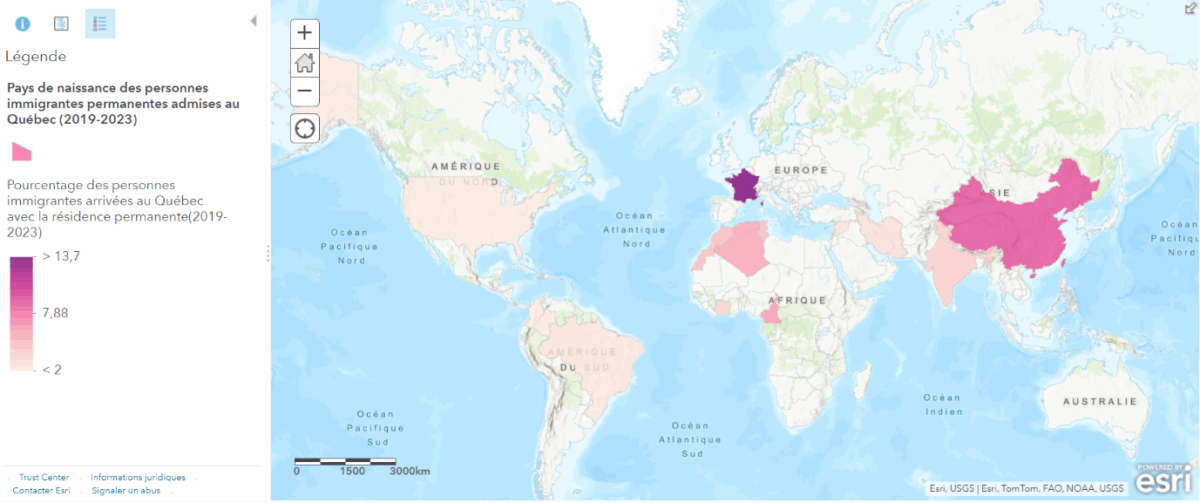
On the map below, discover the 10 main countries of origin of people with permanent residency in Québec.
The immigrant and refugee population is also linguistically diverse.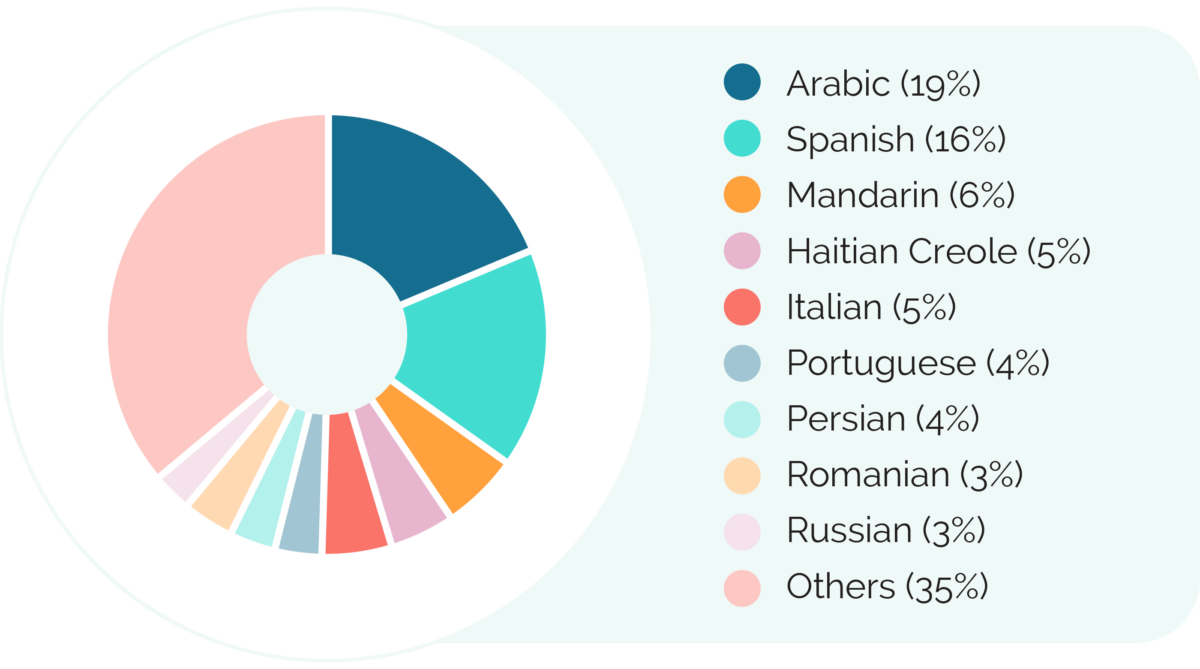
Institut de la statistique du Québec. (2024). Le bilan démographique du Québec (p. 107). Gouvernement du Québec. https://statistique.quebec.ca/fr/fichier/bilan-demographique-quebec-edition-2024.pdf
Statistique Canada. (2022). Série « Perspective géographique », Recensement de 2021—Québec. https://www12.statcan.gc.ca/census-recensement/2021/as-sa/fogs-spg/page.cfm?lang=F&topic=8&dguid=2021A000224
Auclair, S. C., Frigon, C., & St-Amant, G. (2023, août 22). Faits saillants sur la langue anglaise au Québec en 2021. Statistique Canada. https://www150.statcan.gc.ca/n1/pub/89-657-x/89-657-x2023016-fra.htm
Statistique Canada. (2025). Tableau 98-10-0364-01 Langue maternelle selon le statut des générations et le nombre de langues connues : Canada, provinces et territoires, régions métropolitaines de recensement et agglomérations de recensement y compris les parties. Gouvernement du Canada. https://doi.org/10.25318/9810036401-fra
6. True or false? The French spoken in Québec is the same as in France.
False
The French spoken in Québec is a variety of French. It is different than the French spoken in Europe or in countries that were colonized by France or Belgium. It is characterized by accents, words, expressions and pronunciations that are typical of the province and some regions of Québec.
“Québec French can be hard to understand at first. Take the time to get used to it!”
7. True or false? In Québec, the Catholic Church has a lot of influence over the government.
False
In the early 20th century, the Catholic Church was a big part of life in Québec. It played a leading role in education, social assistance and health care.
Beginning in the 1960s, with the Quiet Revolution, the church lost its influence and stepped back from social and educational institutions.
Today, the government handles these responsibilities. In this way, it maintains Québec’s secularism.
To find out more
Warren, J.-P., & Ma, C. (2023). Laïcité au Québec. https://www.thecanadianencyclopedia.ca/fr/article/laicite-au-quebec
Alloprof. (s. d.). L’influence de l’Église catholique au début du 20e siècle. Alloprof. Consulté 11 février 2025, à l’adresse https://www.alloprof.qc.ca/fr/eleves/bv/histoire/l-influence-de-l-eglise-catholique-au-debut-du-2-h1624
8. True or false? Québec is ruled by the king of England.
False
The king or queen of England is Canada’s head of state, but they have a symbolic role with no political power.
The premiers of each province and territory of Canada are responsible for their government’s policies and activities.
9. True or false? Québec is a liberal democracy.
True
In Québec, democracy is based on the protection of individual rights and freedoms.
Political freedoms
- Freedom of expression: expressing your opinions without fear of punishment or persecution
- Freedom of association: belonging to a group that defends specific rights (a union, a political party, etc.)
- Freedom of assembly: participating in a protest or gathering without disturbing the peace
- Freedom of religion: choosing and practising your religion without fear of punishment or persecution
Right to gender equality
In Québec, men and women have equal rights in all aspects of life.
This protects women in several ways:
- Right to security, bodily integrity and dignity
- Right to vote
- Access to education and freedom to choose your field of study
- Freedom to choose your job
- Financial independence
- Access to free and legal abortion
- Access to paid parental leave
Right to vote
Liberal democracy is “representative,” since citizens elect their political representatives.
In Québec, Canadian citizens have the right to vote if they:
- Are aged 18 or over
- Have lived in Québec for more than 6 months
To find out more
Dumontier, J. (2024). The Charter of Human Rights and Freedoms Made Easy (p. 39). Commission des droits de la personne et des droits de la jeunesse. https://www.cdpdj.qc.ca/storage/app/media/publications/Charte_simplifiee_EN.pdf